Wide Plank and Herringbone: Choosing a Floor Layout
August 11, 2026 · All About Floors NW
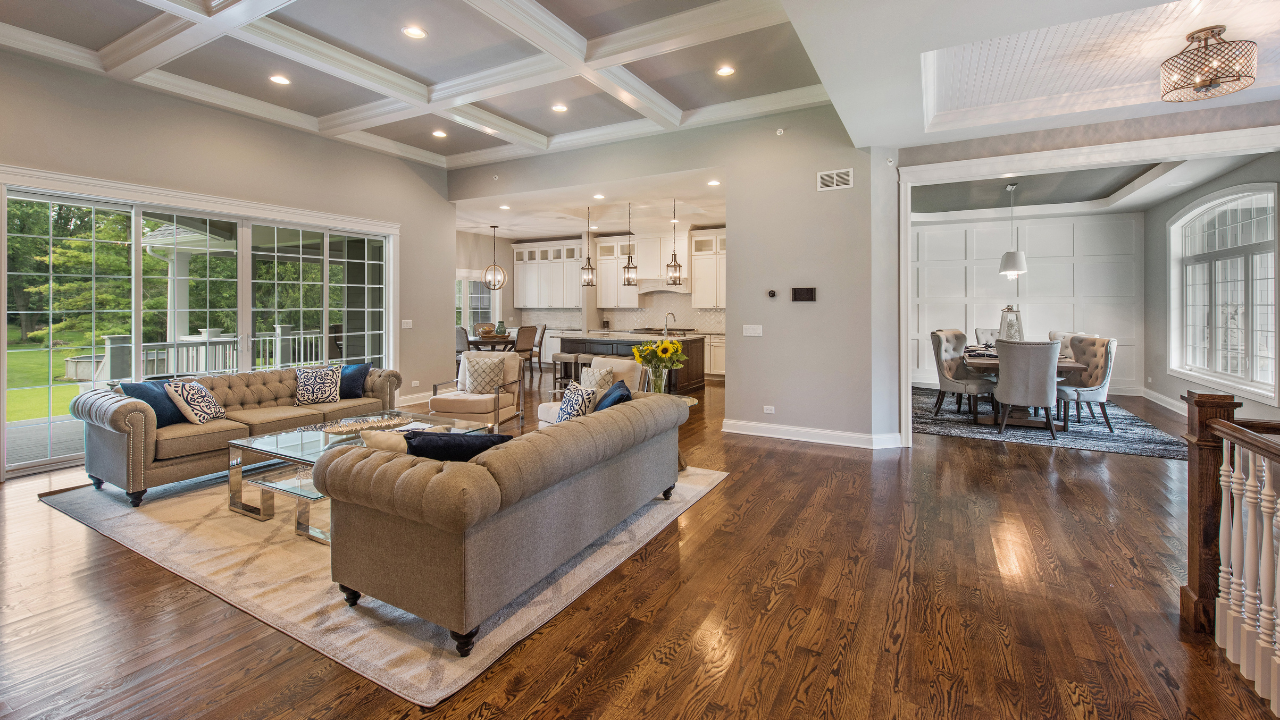
Most people choose a floor by colour and species. Board width and layout pattern usually get decided by default — and they change how a room reads more than colour does.
Here is what the two most-asked-about options actually involve.
Wide plank
Standard strip flooring has been narrow for most of the last century, largely for practical reasons. Wider boards are now widely available and they change a room noticeably.
What it does visually. Fewer seams across the same area means a calmer floor. In an open-plan space where you can see a lot of floor at once, narrow strip can read as busy — all those lines competing with everything else in the room. Wide plank quiets that down, and the effect is usually described as looking more expensive even when it is not.
It also lets the wood grain show properly. A dramatic grain pattern on a narrow board is chopped up by seams every few inches; on a wide board you see the whole figure.
The trade-off. Wood moves with humidity, and each board changes by a percentage of its width. A wider board therefore moves more in absolute terms, so seasonal gaps are more visible than they would be on narrow strip.
This matters in the Pacific Northwest, where we swing from very damp outdoors to dry heated air indoors. It is the main reason we usually steer people toward engineered wide plank rather than solid: the cross-laminated core is dimensionally far more stable, which is exactly the property you want when the board is wide. Our engineered versus solid comparison covers that difference in detail.
Subfloor matters more. A wide board is stiffer and spans further, so it will not follow a dip in the subfloor — it will bridge it, and that becomes a hollow spot underfoot. Wide plank raises the standard for how flat the subfloor needs to be.
Herringbone and chevron
These get used interchangeably and are not the same thing.
Herringbone is rectangular boards laid at 90 degrees to each other in a staggered zigzag — the end of one board meets the side of the next.
Chevron boards are cut at an angle at each end so the pieces meet point to point, forming continuous unbroken Vs. It is a cleaner, more formal look and it costs more because the boards are specially cut.
Where they work. Both draw the eye and create movement, so they suit spaces where the floor is meant to be a feature — an entryway, a formal dining room, a defined zone within a larger open plan. Using herringbone to mark out a section of a big room is one of the more effective things you can do with flooring.
What it costs you. Two things, and both are real:
Installation takes considerably longer. Every piece is angled, the layout has to be set out precisely from a centre line at the start, and an error early on propagates across the whole floor. This is skilled work and it is priced accordingly.
Waste is higher. All those angled cuts generate offcuts that cannot be used elsewhere, so you buy more material than the room’s square footage implies. That overage is not padding — it is genuinely consumed.
The border question. How the pattern stops at the walls matters enormously and is easy to overlook when you are looking at a photo of the middle of a floor. A border treatment frames the pattern and hides the terminating cuts; running the pattern straight into the wall is a different, more contemporary look that leaves those cuts visible. Decide this at the quoting stage, not on install day.
Direction, whichever you choose
Running boards along the longest dimension of a room generally makes it read longer. Running them across can make a narrow room feel wider. Running them toward the main light source tends to minimise how visible the seams are, because you are not raking light across every joint.
There is also a structural consideration: over a wood subfloor, boards ideally run perpendicular to the joists beneath. Where that conflicts with the look you want, it is solvable, but it may mean additional subfloor preparation. Worth knowing before you set your heart on a direction.
Seeing it properly
Neither of these is a decision to make from a sample chip. Board width in particular is very hard to judge from anything smaller than a few boards laid together, and pattern is almost impossible to judge from a photograph.
Come and see full boards in the showroom, or book a free in-home estimate and we will bring samples into the actual room, in your light, running in the direction you are considering. Our hardwood species and finishes guide covers the other half of the decision.
Frequently asked questions
- Does wide plank flooring make a room look bigger?
- Generally yes. Fewer seams across the same floor area reads as a calmer, less busy surface, and that tends to make a space feel larger. The effect is most noticeable in open-plan rooms where a narrow-strip floor can look restless.
- Is herringbone much more expensive to install?
- Yes, on both counts that matter. It takes considerably longer to lay because every piece is angled and the pattern has to be set out precisely from the start, and it generates more offcut waste because of all the angled cuts. Budget for more material than the room's square footage suggests.
- Do wide planks gap more in winter?
- They can show it more. Each board shrinks by a small percentage of its width, so a wider board gives up more absolute width than a narrow one, and the gap at each seam is correspondingly more visible. Engineered wide plank is more dimensionally stable than solid and is usually the better choice at wider sizes.
- Can herringbone work in a small room?
- It can, and it often looks excellent in an entryway or a small formal space where the pattern becomes the feature. The thing to watch is the border detail, because a small room has proportionally more perimeter and how the pattern terminates against the walls becomes very visible.